
There are 140 million births annually and at least 20% (29.4 million) are c-sections. The prevalence of hernias subsequent to lower transverse incisions is poorly characterised. The incidence of hernia in people who have received surgery through this incision type is typically estimated to be between 0% and 5%. With c-sections one of the most commonly performed surgical procedures worldwide, up to 1.47 million people per year may be affected with intra-parietal hernia.
What is a LATI Hernia (LATI-H)?
Lower abdominal transverse incisional / interparietal hernias (LATI-H) are a type of hernia where there is a defect in the posterior sheath, arising from a lower abdominal transverse incision, which subsequently causes hernias to form within the lower abdominal wall. The hernias in question do not necessarily breach the anterior fascia of the rectus sheath, making them difficult to detect clinically. Small defects in the abdominal wall are often asymptomatic and cause minimal discomfort, however, in other people they may cause debilitating symptoms.
Until recently, LATI-H have not been comprehensively described and have not been classified, contributing toward difficulties in recognising what can be symptomatic hernias. Patients may present with pelvic or back pain and even obstruction. In those who are living with these hernias, there is a lack of data describing who has symptoms, the pattern of these and the optimal treatment. LATITUDE 1 aims to address this by describing the incidence and symptomatology of LATI-H.
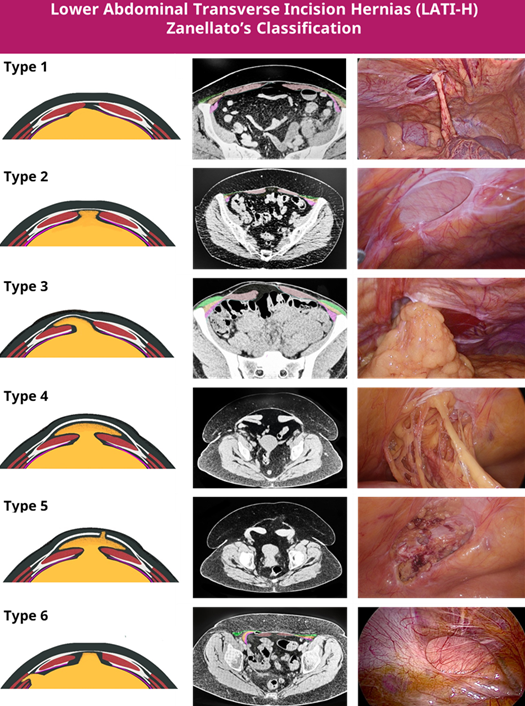
A new classification of these has recently been described by Zanellato et al. as shown below.
What is the LATITUDE project?
The LATITUDE project aims to provide an accurate estimate of the burden of lower abdominal transverse incisional hernias (LATI-H) and to identify how many of these may be symptomatic. This will allow us to understand how many patients are affected by this and to raise awareness and improve management for patients who are affected by pain or other symptoms caused by these hernias.
How can I help?
You can take part in the LATITUDE project. See below for information on how to sign up your centre to the LATITUDE project and be part of improving healthcare for people affected by LATI hernias.
Read our study protocol for more information here